The Price of a Degree: What India's Student Borrowers Are Really Paying.

Loan volumes have nearly tripled since 2014, interest rates fell sharply through 2025-26, and a two-track lending system means where a loan is cheapest depends less on financial need than on which institution admitted the borrower.
Edcom Research. · Akshara J Menon · September 2026 · 12 min read
An education loan is often described as an investment in the future. For many families, though, it is also a large financial commitment that can last well beyond graduation. The question is not simply how much students borrow, but how much they will have to repay, and whether the degree will help them manage that repayment.
Between 2014 and 2025, India’s outstanding education loan portfolio nearly tripled, expanding from ₹52,327 crore to ₹1,37,474 crore. On paper, a 9.5% annual compound growth rate points toward a boom in student credit.
The regulatory data shows a different picture. Over those same eleven years, the total number of active education loan accounts nationwide fell from 23.36 lakh to 20.63 lakh.
Fewer students are borrowing. Those who do are taking on substantially heavier balances.
The average outstanding balance per account climbed from ₹4.07 lakh in 2021 to ₹6.66 lakh by March 2025. Following a pandemic-era low of ₹11,558 crore across 4.07 lakh accounts in FY21, annual credit disbursements recovered to ₹28,699 crore across 7.36 lakh accounts by FY24. Total lending volume doubled while borrower additions grew at a far more modest pace.
This reflects rising tuition inflation across professional degrees and overseas programs, with debt consolidating among a smaller group of families taking on large financial commitments for a single qualification.
EDCOM INSIGHT: A loan book growing at close to 9.5 per cent a year while the number of borrowers shrinks is not a story about more Indian families gaining access to credit. It is a story about the families who already have that access taking on more of it, year after year, to keep pace with the rising cost of the same degrees.
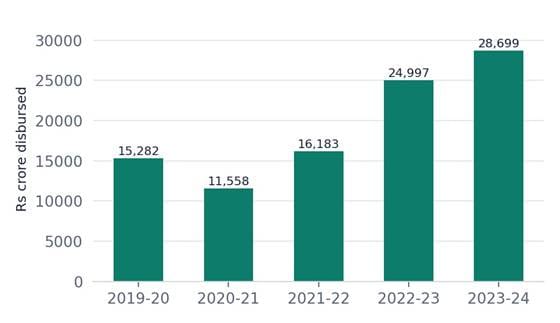
Loans disbursed each year, all banks (₹ crore). Source: Rajya Sabha Unstarred Question AU-2460.
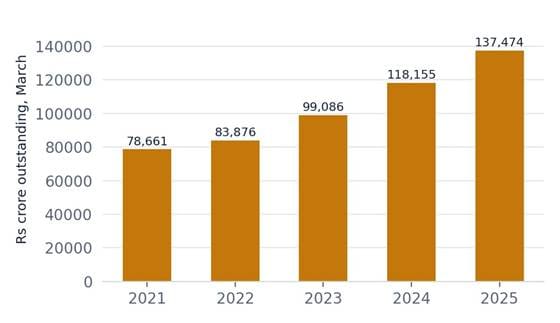
Credit outstanding, March of each year (₹ crore). Source: Parliamentary Standing Committee on Education, citing RBI.
A scheme built to close the gap
T In November 2024, the Union Cabinet cleared the PM Vidyalaxmi scheme to support higher education financing. The program provides collateral-free, guarantor-free credit to students admitted to 1,425 designated Quality Higher Education Institutions (QHEIs). This cohort is selected from the top 100 private institutions, top 200 government institutions, and all central institutions ranked under the National Institutional Ranking Framework (NIRF).
Under PM Vidyalaxmi, loan interest is capped at the lending institution's External Benchmark Lending Rate (EBLR) plus 0.5%, with an additional 1% concession for borrowers who service interest during their study moratorium. The government extends a 75% credit guarantee on facilities up to ₹7.5 lakh, while applicants from families earning up to ₹8 lakh annually qualify for a 3% interest subvention on balances up to ₹10 lakh. With a ₹3,600 crore budget through 2030–31, the initiative targets around seven lakh scholars.
During its initial year of operation, the unified application portal handled 6.45 lakh education loan submissions across all categories, with 1.10 lakh designated for PM Vidyalaxmi. Banks sanctioned 70,852 applications and disbursed 67,728, recording an approval rate of roughly 64% and high conversion to disbursement. Men submitted more applications than women (3.68 lakh versus 2.77 lakh), yet sanction rates across both cohorts were closely matched, indicating that disparity originates prior to institutional application review. In Andhra Pradesh, for example, 5,059 loans worth ₹579.76 crore were sanctioned, and ₹102.93 crore across 4,405 accounts was disbursed between February 2025 and January 2026.
The qualification parameters create a structural division. Because PM Vidyalaxmi ties lower interest rates and federal guarantees strictly to NIRF rankings and central institutions, state exposure to default risk is constrained. However, this framework leaves out the vast majority of students enrolled in Tier-2 and Tier-3 private colleges, who make up the largest share of the borrower market and continue to rely on commercial lending rates.
EDCOM INSIGHT: PM Vidyalaxmi's eligibility list runs entirely on NIRF rank. A scheme built to widen access to cheap, guaranteed credit is, by its own design, unavailable to most of India's colleges and to most of the students who attend them.
What a loan actually costs
The Reserve Bank of India’s 2025–26 Annual Report showed weighted average lending rates on fresh education loans dropping from 10.41% in March 2025 to 9.14% in March 2026. This 1.27-percentage-point decrease was the largest reduction across retail lending categories that year. Rates on existing balances adjusted down from 10.31% to 9.35%.
Despite these cuts, student financing remains more expensive than residential mortgages. In March 2026, home loans averaged 7.63% for new originations and 7.74% on existing books, while student credit remained above 9%.
Market pricing also varies significantly based on where a student is admitted. An admit entering an IIT, IIM, or NIT can access SBI's Scholar loan at 6.90% to 7.65%. Candidates heading abroad under the bank’s Global Ed-Vantage line pay 8.90% to 9.40%, while ordinary domestic loans through the same lender are priced from 9.40% to 9.90%.
Public lenders such as Punjab National Bank, Canara Bank, and Bank of India list card rates between 8.55% and 12.10%. Private institutions like ICICI, Axis, and HDFC generally quote between 9.50% and 13.50%, and non-banking financial companies (NBFCs) focused on overseas study, including Credila and Avanse, typically start above 10.75% and reach 13.50%.
The lowest available rates go to borrowers who clear premier entrance screenings, while wider candidate pools face higher pricing tiers.
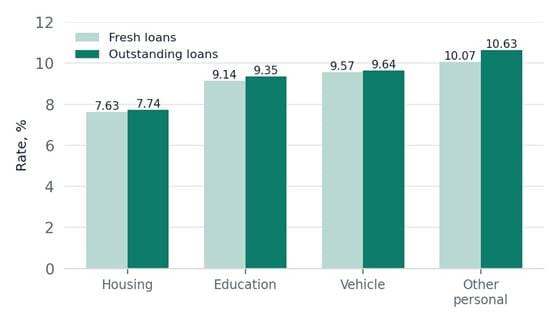
Personal loan rates, March 2026. Source: RBI Annual Report 2025-26.
WHAT A ₹10 LAKH LOAN ACTUALLY COSTS
Illustrative repayment over a 10-year tenure, at the rate ranges cited above. The gap between the cheapest and costliest tier is ₹4.40 lakh in interest alone, on an identical loan amount.
|
Lender tier |
Rate |
Monthly EMI |
Total interest paid |
|
SBI Scholar (IIT/IIM/NIT admits) |
6.90% |
₹11,559 |
₹3,87,125 |
|
RBI system average, fresh loans |
9.14% |
₹12,743 |
₹5,29,216 |
|
SBI ordinary student loan (upper end) |
9.90% |
₹13,160 |
₹5,79,171 |
|
PNB / Canara Bank (upper end) |
11.95% |
₹14,318 |
₹7,18,185 |
|
Private bank / NBFC (upper end) |
13.50% |
₹15,227 |
₹8,27,291 |
That system-wide average, however, conceals a wide spread. A student admitted to an IIT, IIM or NIT can borrow under the State Bank of India's Scholar scheme at 6.90 to 7.65 per cent. A student heading abroad under the bank's Global Ed-Vantage product pays 8.90 to 9.40 per cent, and an ordinary student loan from the same bank runs 9.40 to 9.90 per cent. Other public sector banks, including Punjab National Bank, Canara Bank and Bank of India, quote indicative ranges as wide as 8.55 to 12.10 per cent. Private banks such as HDFC, Axis and ICICI generally start closer to 9.50 per cent and run up to 13.50 per cent, and non-bank lenders that specialise in overseas education loans, such as Credila and Avanse, typically start above 10.75 per cent. The cheapest credit in the system goes to students who have already cleared the hardest admission bar. The costliest goes to everyone else.
EDCOM INSIGHT: The gap between an IIT admit's borrowing rate and an NBFC borrower's upper-end rate runs close to six percentage points. Compounded over a ten-year tenure on an identical ₹10 lakh loan, that gap alone is worth more than ₹4 lakh in interest, roughly what an entry-level graduate earns in a year and a half.
Two lending systems
That divide runs deeper than interest rates. Credila, formerly HDFC Credila and now India's largest dedicated overseas-education lender, grew its loan book from ₹8,838 crore in March 2022 to ₹50,386 crore by December 2025, with roughly four-fifths of that book concentrated in the United States, the United Kingdom and Canada. Its gross stage-3 assets, the non-bank equivalent of a bad-loan ratio, stood at just 0.3 per cent. Avanse Financial Services shows a similar pattern: a loan book that grew from ₹3,103 crore in 2021 to ₹23,411 crore by March 2026, four-fifths of it overseas-focused, with loans more than 90 days overdue at only 0.16 per cent.
Asset quality this clean is not evidence of superior underwriting so much as evidence of selection. These lenders serve borrowers headed to countries with strong graduate employment markets, backed by families with the means to absorb a loan of this size in the first place. The credit itself is not cheap, as the rate table shows, but the borrower behind it is a safer bet than the system average, and the low default numbers reflect that, not a lending model other institutions could simply copy.
The public banking system, which still holds the overwhelming majority of the country's education loan accounts, serves a broader and financially thinner population than the overseas-focused NBFC segment above, and its asset quality has moved sharply in the same period. The gross non-performing asset ratio on outstanding education loans at public sector banks fell from 7 per cent in FY2020-21 to 2 per cent in FY2024-25, the finance ministry told the Lok Sabha in December 2025, citing RBI data and attributing the improvement to the central bank's stressed-asset resolution framework and the mandatory adoption of the Model Education Loan Scheme across scheduled commercial banks. That brings PSB education loans close to the banking system's overall gross NPA ratio, which stood at a historic low of 2.15 per cent as of September 2025, with public sector banks specifically at 2.50 per cent, private banks at 1.73 per cent, and foreign banks at 0.80 per cent. Even after that improvement, a public sector education loan still carries something like six times Credila's default rate and over twelve times Avanse's, so the two-track pattern described above persists, even as the overall credit cycle turns cleaner across the board. The Reserve Bank has also confirmed it does not maintain state-wise NPA data for education loans, which is part of why a current figure for Kerala, discussed below, is not publicly available.
Where the strain shows up
Kerala offers a ground-level view of that strain. The state's outstanding education loans rose by ₹1,155.71 crore in a single quarter, April to June 2025, to reach ₹10,472.48 crore across 2.67 lakh accounts, a 12.4 per cent quarterly increase. In 2017, the state's loan book of ₹10,220 crore carried ₹1,315 crore in non-performing assets, a ratio of close to 13 per cent, prompting the state government to launch a ₹900 crore repayment-assistance scheme for families earning below ₹6 lakh a year. A more recent, equally granular figure for the state does not appear to be publicly available.
Survey data compiled by the Centre for Public Policy Research on Kerala's overseas-bound student migrants adds a further complication to the popular assumption that such migration is driven by academic merit. Among students who had gone abroad, 38 per cent had scored below 75 per cent in their previous degree, and the overwhelming majority had no engagement with the state's own migrant-support agency, relying instead on private consultancies to manage the process, including, in many cases, the loan itself. Read together with the national lending data, this points to a pattern in which the decision to borrow is often shaped less by a clear-eyed assessment of repayment capacity than by the momentum of a consultancy-driven pipeline, with the loan approved well before the family has fully reckoned with what a decade of repayment at these rates will look like.
Reading the numbers together
Three patterns sit alongside each other in this data. Credit is growing faster than the number of borrowers, which points to rising course cost rather than rising access. The cheapest, best-guaranteed credit is reserved for students who have already cleared the toughest admission filters, while the largest and least visible pool of borrowers pays the most and is tracked the least. And the segment of the market showing the fastest growth and the lowest stress, overseas-focused non-bank lending, is fast precisely because it lends to families who were already the safest bet, not because it has solved the affordability problem the rest of the system still faces.
EDCOM INSIGHT: A gross stage-3 ratio of 0.3 per cent looks like an underwriting triumph. It is closer to a demographic filter. Credila and Avanse are not lending to India's neediest borrowers. They are lending to the ones least likely to ever need help repaying.
None of this means an education loan is a poor decision. For a student admitted to a top institute, or one bound for a country with strong graduate outcomes, the loan market has become considerably cheaper over the past year, and schemes such as PM Vidyalaxmi are designed explicitly to widen access to that cheaper tier. The harder question is what happens to the much larger number of borrowers who do not fit that profile, whose loans cost more, whose institutions carry no comparable guarantee, and whose repayment stress is the part of the system that current data describes least well.
Sources
• Reserve Bank of India, Annual Report 2025-26, Chapter III, Tables III.6 and III.7 (sector-wise weighted average lending rates)
• Rajya Sabha Unstarred Question AU-2460, Session 266, on education loan accounts and amounts disbursed, 2019-20 to 2023-24
• Parliamentary Standing Committee on Education report, citing Reserve Bank of India data on outstanding education credit, 2014 and 2021-2025
• Press Information Bureau backgrounder on the PM Vidyalaxmi scheme, 29 July 2026
• Lok Sabha Unstarred Question No. 1493, state-wise PM Vidyalaxmi application data, 9 February 2026
• Press Information Bureau / Lok Sabha reply, Minister of State for Finance, 15 December 2025: PSB education loan gross NPA ratio, FY2020-21 to FY2024-25
• Lok Sabha reply, Minister of State for Finance, February 2026: system-wide gross NPA ratio of scheduled commercial banks, September 2025
• ICRA rating rationales for Credila and Avanse Financial Services
• Credila Annual Report, FY 2024-25
• State Level Bankers' Committee, Kerala, and state reporting on education loan volumes and non-performing assets
• Centre for Public Policy Research, survey findings on Kerala's overseas student migrants
• Indicative bank and lender interest rate ranges published by individual lenders, compiled mid-2026