The Economics of Educational Choice: What Your Degree Costs, and What It Actually Pays.


EdCom Research. Akshara J Menon · July 2026 · 9 min read
For generations people thought higher education is one of the safest investment a student can make. The logic was simple: earn a degree, secure a good job, and enjoy a better career prospects. However, in today's rapidly evolving and growing labour market, the relationship between education and employment is becoming increasingly challenging . A higher education doesn’t automatically guarantee you a job. India produces more graduates than its labour market can actually absorb, the labour supply and labour demand has a huge gap. Domestic postgraduate unemployment has converged with graduate unemployment – statistically erasing the degree premium.
Investing in education is not just about spending money; it is also about dedicating years of effort, time, and personal growth. For many middle-class families, funding a child's education is one of the biggest financial commitments they will ever make. It often involves supporting a student through four to eight of the most important years of their life. However, the cost of obtaining a degree has risen sharply over time, while the financial rewards of higher education have not increased at the same pace. At the same time, labour markets are struggling to create enough opportunities for the growing number of graduates entering the workforce, making educational choices more complex and consequential than ever before.
The cost landscape
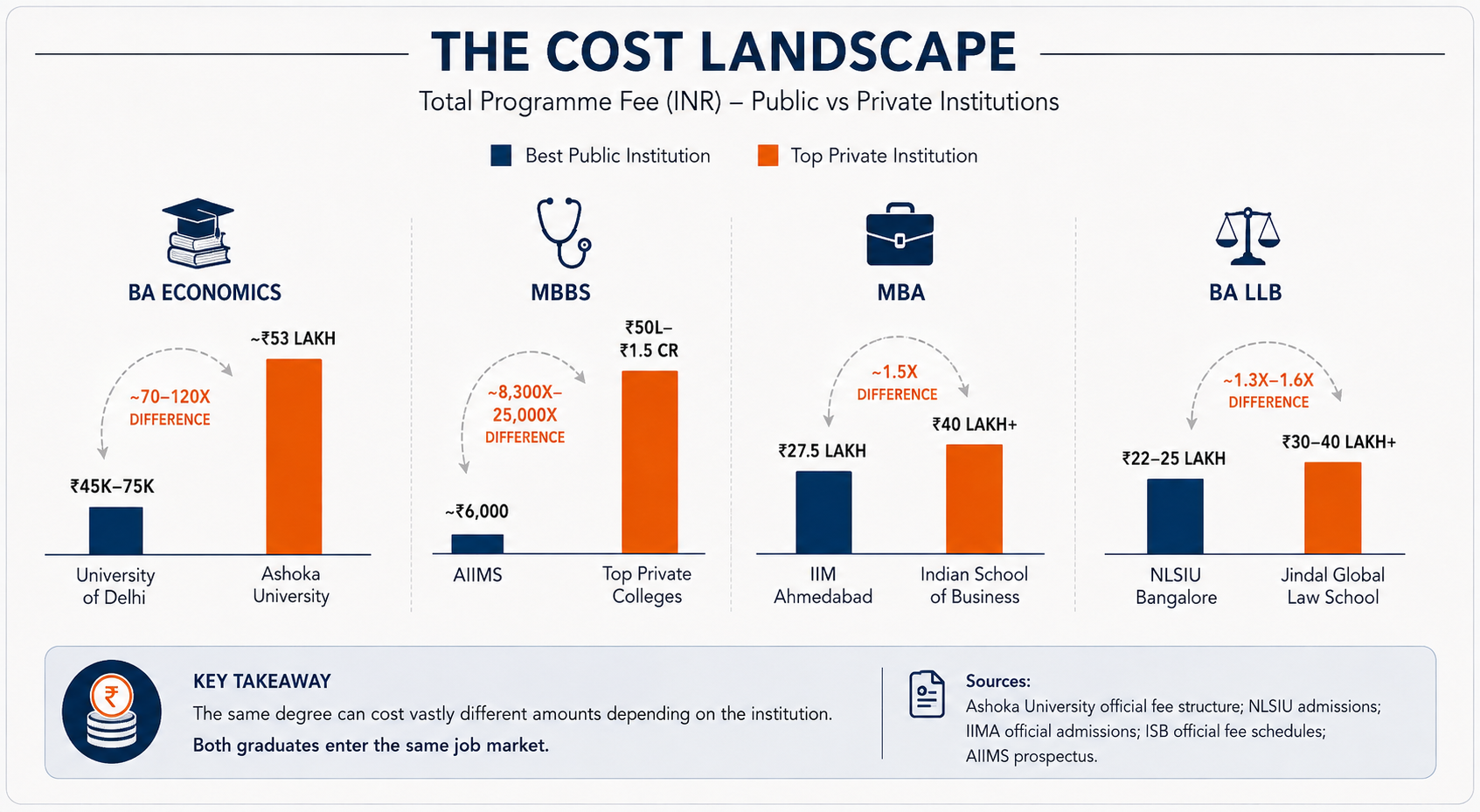
The following data, drawn from official institutional fee structures, documents the verified cost differential across key credentials.
|
Degree |
Best public institution |
Public fee |
Top private institution |
Private fee |
|
BA Economics |
University of Delhi |
₹15,000–25,000/yr
(₹45,000–75,000 total) |
Ashoka University |
~₹53 lakh (total) |
|
MBBS |
AIIMS |
~₹6,000 total |
Top private colleges |
₹50L–₹1.5 Cr |
|
MBA |
IIM Ahmedabad |
₹27.5 lakh |
Indian School of Business |
₹40 lakh+ |
|
BA LLB |
NLSIU Bangalore |
₹22–25 lakh total |
Jindal Global Law School |
₹30–40 lakh+ |
Sources: Ashoka University official fee structure; NLSIU admissions; IIMA official admissions; ISB official fee schedules; AIIMS prospectus.
The same BA Economics credential costs roughly ₹45,000–75,000 for the full three-year programme at Delhi University and ₹53 lakh at Ashoka — a difference of roughly 70–120x depending on the DU college, once both figures are compared on a like-for-like, total-course basis. Both graduates enter the same market.
The asymmetry of the medical degree
Nowhere is the fee chasm more consequential than medicine. AIIMS charges approximately ₹6,000 for the entire MBBS programme — effectively free. A comparable credential from a top private medical college costs between ₹50 lakh and ₹1.5 crore. Both graduates sit the same NEXT licensing examination.
The return landscape
The following data is compiled from AmbitionBox, Glassdoor India, Payscale India, and Indeed India. These figures represent the realistic entry-level market, not aspirational placement brochures.
|
Education level / sector |
Typical role |
Entry salary |
Mid-career (5+ yrs) |
|
B.Com |
Junior accountant |
₹2.0–3.0 LPA |
₹5.5–10.0 LPA |
|
B.Com at Big-4 |
Audit associate
(EY/PwC/KPMG) |
₹4.5–6.5 LPA |
₹10–18 LPA |
|
BA Humanities |
HR executive / recruiter |
₹2.5–4.0 LPA |
₹6–10 LPA |
|
BA Economics / Data |
Business analyst /
consultant |
₹5.0–13.6 LPA |
₹14–25 LPA |
|
B.Sc Computer Science |
Junior data analyst |
₹3.5–5.5 LPA |
₹9–15 LPA |
|
Engineering (Software) |
Software engineer |
₹6.5 LPA (median) |
₹15–30 LPA |
|
MBA (top tier) |
Operations / brand manager |
₹10.6–17.9 LPA |
₹22–40+ LPA |
|
MBBS |
Junior doctor / medical
officer |
₹6.0–9.6 LPA |
₹15–25 LPA |
|
MD / MS (Specialist) |
Post-graduate specialist |
₹12.0–18.0 LPA |
₹24–60+ LPA |
|
CA |
Finance / risk analyst |
₹8.0–11.5 LPA |
₹18–35 LPA |
~ Sources: AmbitionBox 2025–26 registry; Glassdoor India; Payscale India; Indeed India.
The ROI paradox of premium domestic education.
A student paying ₹53 lakh for an Ashoka BA Economics enters a market where the median Business Analyst starting salary is ₹5.5 LPA. At a 30% savings rate, tuition alone requires over 30 years to recover relative to a DU graduate paying ₹25,000 for an identical entry-level credential. The IIM MBA at ₹27.5 lakh — where median placements exceed ₹25 LPA — presents a fundamentally different return profile.

Looking beyond the degree
Educational decision should not be solely based on institutional degree. A costly qualification doesn’t guarantee a higher employment prospects or higher pay.
Second, students should evaluate the educational decisions and outcome through a broader lens of understanding the market requirements that includes employability, industry demand, skill development, and expected career progression. Finally understanding the return on investment has become important, the true value of higher education doesn’t lie in obtaining a higher qualification rather it depends upon the opportunity it creates after obtaining the degree.
Higher education remains one of the most powerful investments individuals can make. However, the relationship between educational costs, employability, and earnings is becoming increasingly complex.
The data suggests that success in today's labour market depends not simply on earning a degree, but on choosing educational pathways that align with evolving industry needs and future career opportunities.
For students making one of the most important decisions of their lives, informed choices matter more than ever.
Sources:
Ashoka University Fee Structure.
AIIMS Prospectus.
IIM Ahmedabad Admissions.
ISB Fee Schedules.
NLSIU Admissions.
AmbitionBox (2025–26)
Glassdoor India.
Payscale India.
Indeed India.
© 2026 EdCom. All rights reserved. For permissions and media enquiries, contact advisory@edcom.in