What India's Students Are Choosing, and What the Job Market Actually Wants
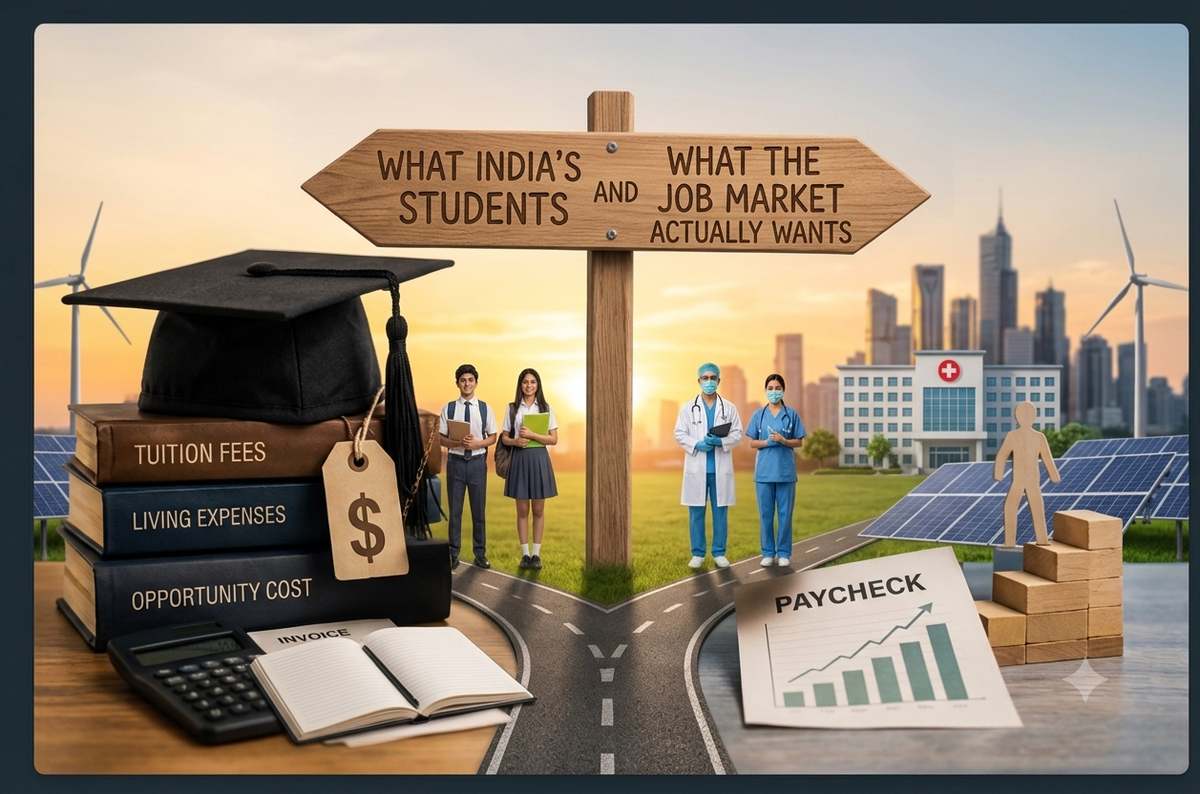
A cross analysis of India's official education and admissions data alongside new labour data from the World Economic Forum and the US Bureau of Labor Statistics finds India's toughest competition and the world's fastest growing jobs pointing in different directions.
Edcom Research Desk · Akshara J Menon · July 2026 · 10 min read
If you look at the raw numbers of what students are choosing versus what the job market wants, they tell a pretty predictable story. We know which degrees are currently in demand, which entrance exams keep lakhs of students awake at night, and which grads are left scrambling for work. But if you step back and look at India’s education trends alongside fresh global labor data from the World Economic Forum (WEF) and the US Bureau of Labor Statistics (BLS), a much bigger, slightly unsettling reality check emerges.
Enrolment and admissions figures are drawn from AISHE, NTA, JoSAA and AICTE data. This piece reads them alongside the World Economic Forum's Future of Jobs Report 2025, the US Bureau of Labor Statistics, LinkedIn's Jobs on the Rise 2026, and NITI Aayog's services sector data. See Sources.
What India's Students Are Actually Choosing
All India Survey on Higher Education (AISHE) data shows that some of the country's fastest growing degree programs rarely make the news. Pharmacy enrolment nearly doubled between 2017-18 and 2021-22, from 2.25 lakh to 4.52 lakh students, a trend so consistent that its statistical fit is close to a perfect straight line. Nursing shows almost the same shape, rising from 2.39 lakh to 4.00 lakh over the same years, plausibly tracking sustained overseas demand for Indian trained nurses. Business administration posted the cleanest growth line in the entire dataset, expanding from 4.25 lakh to 6.65 lakh students at close to 11.6 per cent a year. Engineering, by contrast, has been flat to declining, slipping from 39.40 lakh students in 2017-18 to 38.45 lakh by 2021-22, even as it continues to dominate career advice content aimed at Indian students.
At the same time, admissions data from the National Testing Agency, JoSAA and AICTE shows that the fiercest competition in Indian higher education is concentrated in a narrow band of institutions that account for a small share of total capacity. About 81 candidates compete for every seat at an IIT and close to 148 at an IIIT, the most contested category in that data. Government medical college seats see about 38 applicants for every place. Yet these headline numbers describe only a sliver of the system: private and state engineering colleges, which hold more than 95 per cent of India's roughly 23.5 lakh engineering seats, are so undersubscribed that seats outnumber applicants in some categories. The scarcity that dominates public conversation about Indian education sits in a small, elite corner of a much larger and considerably less competitive system.
|
Programme or
Category |
What the Official
Data Shows |
|
Pharmacy |
Enrolment nearly doubled: 2.25 lakh to 4.52 lakh
students, 2017-18 to 2021-22 |
|
Nursing |
Enrolment nearly doubled: 2.39 lakh to 4.00 lakh
students, same period |
|
Business Administration (BBA) |
Enrolment rose from 4.25 lakh to 6.65 lakh,
growing close to 11.6% a year |
|
Engineering (all seats) |
Enrolment flat to declining: 39.40 lakh to 38.45
lakh students, 2017-18 to 2021-22 |
|
IITs (JoSAA) |
About 81 applicants compete for every seat |
|
IIITs (JoSAA) |
About 148 applicants compete for every seat, the
most contested category measured |
|
Government MBBS |
About 38 applicants compete for every seat |
|
Private engineering colleges |
Seats outnumber applicants; over 95% of India's
engineering capacity sits here, largely uncontested |
Enrolment figures from AISHE, 2017-18 to 2021-22; competition figures from National Testing Agency, JoSAA and AICTE data, 2025 admission cycle.
What the Global Market Is Actually Demanding
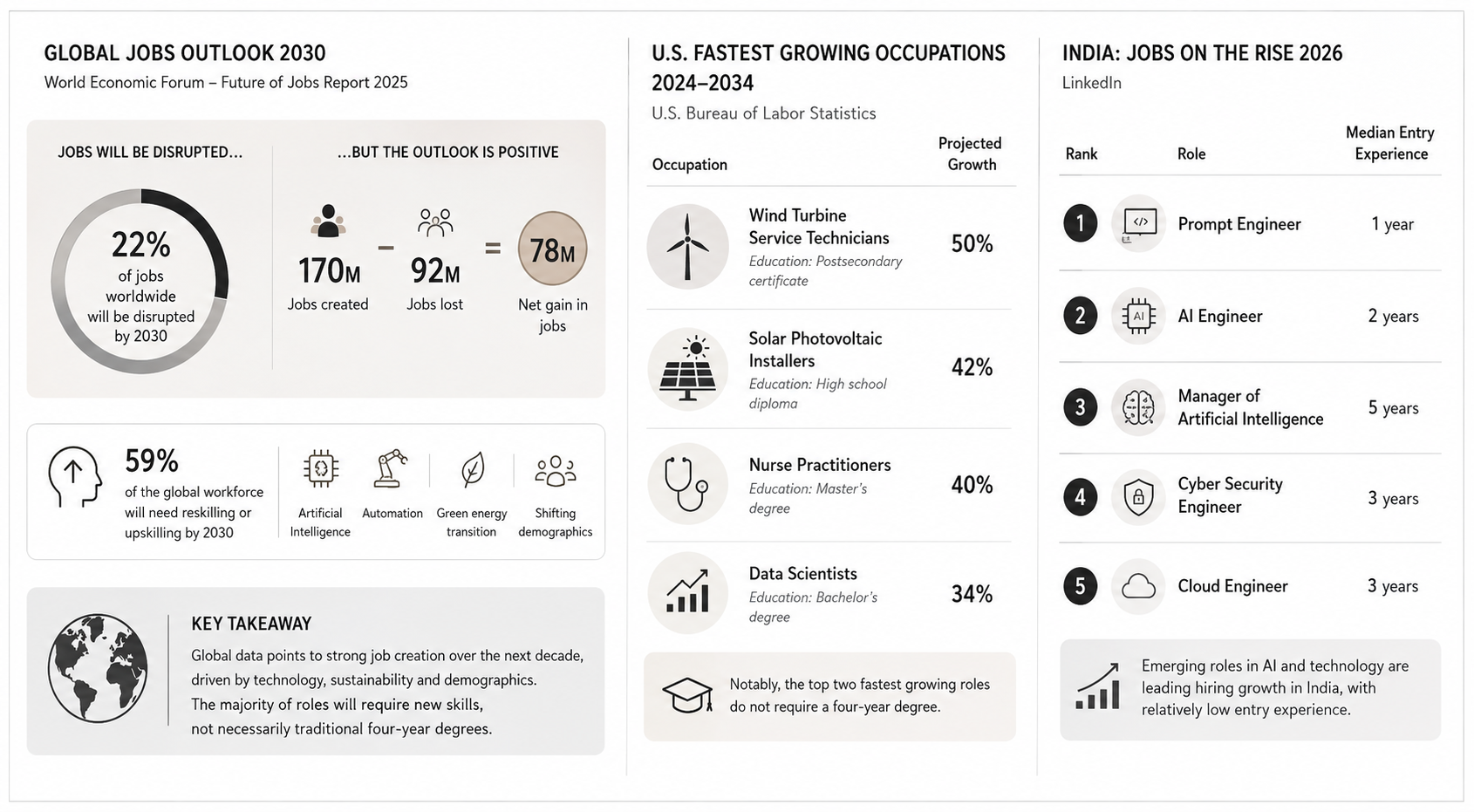
On the demand side, two pieces of global data sketch a fairly consistent picture. The World Economic Forum's Future of Jobs Report 2025 projects that 22 per cent of jobs worldwide will be disrupted by 2030, with 170 million created against 92 million lost, a net gain of 78 million jobs, driven chiefly by artificial intelligence, automation, the green energy transition and shifting demographics. Fifty nine per cent of the global workforce is expected to need reskilling or upskilling within the same window.
The US Bureau of Labor Statistics puts numbers to a similar story for 2024 to 2034. Its fastest growing occupations are wind turbine service technicians, projected to grow 50 per cent, solar photovoltaic installers at 42 per cent, nurse practitioners at 40 per cent and data scientists at 34 per cent. Notably, neither of the two fastest growing roles on that list requires a four year degree: a postsecondary certificate is enough for a wind technician, and a high school diploma for a solar installer. India's own hiring data tracks a version of the same shift. LinkedIn's Jobs on the Rise 2026 ranking for India places Prompt Engineer, a role that barely existed as a job title three years ago, at the very top, with a median entry experience of just one year, followed closely by AI Engineer and Manager of Artificial Intelligence.
Where Supply and Demand Actually Meet
When India's education trends are compared with global labour market projections, some patterns become immediately apparent. The sharp rise in nursing and pharmacy enrolment over the past four years is one of the clearest examples of student choices aligning with sustained global demand. The same healthcare expansion is reflected in the US Bureau of Labor Statistics' employment projections and echoed in Indian government data, which identifies healthcare technology as one of the country's fastest-growing sectors. A similar convergence is visible in artificial intelligence. AI-related roles now dominate LinkedIn's list of India's fastest-growing jobs, mirroring the World Economic Forum's identification of AI as the most significant driver of labour market transformation and the Bureau of Labor Statistics' projections for rapid growth in data science and analytics occupations. Together, these trends suggest that while not all educational pathways are keeping pace with changing workforce needs, some sectors are already moving in step with the direction of the global economy.
Where the Trends Diverge
The alignment between education and employment begins to weaken in other sectors. According to the US Bureau of Labor Statistics, the two fastest-growing occupations over the next decade-wind turbine service technicians and solar photovoltaic installers-typically require only a certificate or diploma rather than a four-year engineering degree. In contrast, India's technical education system continues to revolve around highly competitive seats at the IITs, NITs and IIITs. At the same time, engineering enrolment has remained flat or declined even as AI-related roles have emerged as some of India's fastest-growing occupations, suggesting that much of this demand is increasingly being met through shorter, skills-based learning pathways rather than traditional engineering programs.
The value of educational scarcity is also becoming less certain. RTI disclosures indicate that between 38 and 40 per cent of IIT graduates remain unplaced despite graduating from some of India's most prestigious engineering institutions. Entry-level salary data from AmbitionBox, Glassdoor India, Payscale India and Indeed India further suggests that in several fields, the earnings gap between graduates and postgraduates has narrowed considerably, reducing the wage premium traditionally associated with an additional degree. Meanwhile, NITI Aayog's analysis of India's services sector-the largest source of graduate employment-shows that only around one in four graduates and fewer than two in five postgraduates hold regular salaried jobs. Together, these findings suggest that securing one of India's most competitive college seats no longer guarantees the employment outcomes that students and families have long associated with academic prestige.
The Pattern Across Every Piece
Taken individually, none of these datasets could have shown this. Read together with new data from the World Economic Forum and the US Bureau of Labor Statistics, a single thread runs through all of them: the parts of India's education system generating the fiercest competition, elite engineering, government medical colleges, top law schools, are not the same parts most closely aligned with where global demand, by the WEF and BLS's own measures, is actually growing. The programs that are aligned, nursing and pharmacy chief among them, draw comparatively little of the attention or competitive intensity that Indian students and their families currently direct toward degrees whose payoff, on the official data itself, is no longer guaranteed.
Sources
● World Economic Forum. Future of Jobs Report 2025.
● US Bureau of Labor Statistics. Occupational Outlook Handbook and Employment Projections, 2024-2034.
● LinkedIn Economic Graph. Jobs on the Rise 2026: The 25 Fastest-Growing Jobs in India.
● NITI Aayog. India's Services Sector: Insights from Employment Trends and State Level Dynamics. October 2025.
● National Testing Agency, Joint Seat Allocation Authority (JoSAA), All India Council for Technical Education (AICTE) and Consortium of National Law Universities. 2025 admission cycle data.
● All India Survey on Higher Education (AISHE), Ministry of Education, Government of India, 2021-22, cross-checked against AICTE and National Medical Commission dashboards.
● Institutional fee schedules: Ashoka University, NLSIU Bangalore, IIM Ahmedabad, Indian School of Business, AIIMS. Salary data: AmbitionBox, Glassdoor India, Payscale India and Indeed India, 2025-26.
● Ministry of External Affairs, Government of India, 2025; RTI disclosures on IIT placement rates, 2024.
© 2026 Edcom. All rights reserved. For permissions and media enquiries, contact advisory@edcom.in