India Ordered 1,600 New Aircraft. It May Not Have Enough Pilots to Fly Them.
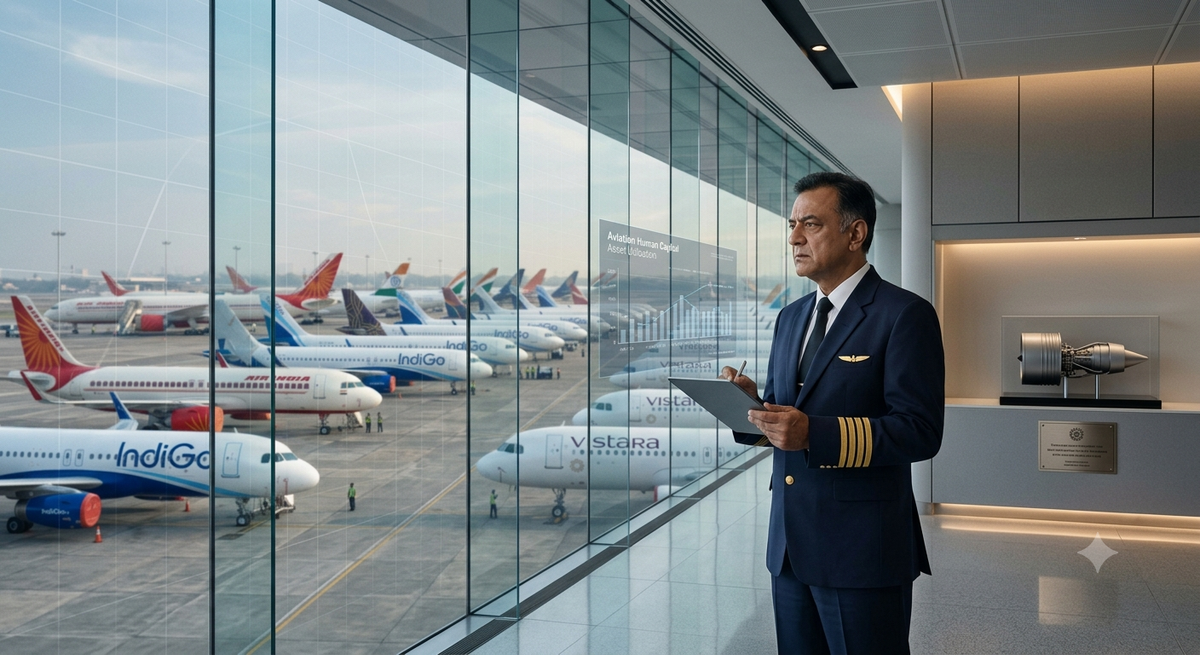
DGCA's fleet and licensing data show an aviation sector that has nearly doubled its fleet in a decade, recovered from the deepest losses in its history, and is now buying aircraft faster than it is training pilots.
Edcom Research Desk, Akshara J Menon |
A Fleet That Nearly Doubled - Then Nearly Doubled Again
At the end of FY2015–16, India's scheduled airlines operated a combined fleet of 448 aircraft. By FY2024–25, that figure had grown to 866, marking a 93% increase in nine years, according to DGCA Table 2B. The journey, however, was far from smooth. The fleet contracted during the pandemic, dropping to 674 aircraft in FY2021–22 as airlines battled for survival. Growth resumed quickly thereafter, with nearly 100 aircraft added in FY2023–24 and another 97 in the following year.
Flight activity followed a similar pattern. Revenue departures by scheduled Indian carriers fell from 12,00,589 in FY2019–20 to just 5,10,084 during the pandemic year FY2020–21. By FY2024–25, they had reached a record 12,44,345—surpassing pre-pandemic levels and standing 51% higher than a decade earlier. Revenue flying hours also climbed steadily over the period, rising 69% from 16,33,386 to 27,67,068.
The composition of the fleet has evolved as well. DGCA's aircraft-type data (Table 2C) show that narrow-body aircraft continue to dominate, led by the Airbus A320/A321 family and Boeing 737 variants. Wide-body aircraft—including the A350, Boeing 777 and 787 used primarily on long-haul international routes—make up only about 8% of the current fleet of 866 aircraft. The numbers suggest that India's aviation expansion continues to be driven largely by domestic and short-haul operations.
|
AT A GLANCE |
|
|
Fleet size, FY2015-16 → FY2024-25 |
|
|
Revenue departures, FY2015-16 →
FY2024-25 |
8,22,984 → 12,44,345 (+51%) |
|
Pending aircraft deliveries
(industry-wide) |
1,600+ (orders placed since
2023: 1,280) |
|
Wide-body share of current fleet |
≈ 8% |

From the Worst Losses on Record to an Operating Profit
DGCA's financial returns for the sector (Table 2G) paint a more nuanced picture of the recovery. Total operating revenue for all scheduled Indian airlines rose from roughly ₹71,965 crore in FY2015–16 to about ₹1.71 lakh crore in FY2024–25, an increase of 137%. During the pandemic, revenue fell to below ₹39,520 crore in FY2020–21 before recovering in the years that followed.
On an operating basis, the sector recorded profits in five of the last ten years, including operating profits of about ₹5,668 crore in FY2023–24 and ₹3,337 crore in FY2024–25, among the strongest performances of the decade. However, financing costs, aircraft lease payments, depreciation and other non-operating expenses erased those gains. The same DGCA data show a net loss after income tax in every one of the last ten years, rising from ₹7,287 crore in FY2015–16 to a pandemic peak of ₹21,324 crore in FY2021–22, before narrowing to ₹5,267 crore by FY2024–25, the smallest loss in several years.
The figures point to a clear trend. Indian airlines are increasingly covering the day-to-day costs of flying passengers, but the debt and lease commitments needed to finance rapid fleet expansion continue to weigh heavily on their overall profitability.
Airports Are Multiplying - Just Not Everywhere Yet
The number of operational airports in India increased from 74 in 2014 to 164 in 2025, according to Airports Authority of India (AAI) and Economic Survey data. Depending on how international, domestic and civil enclave airports are classified, AAI directly manages between 125 and 154 of these. Of the 487 airports and airstrips that exist across the country, only about one-third are currently operational, highlighting the gap the government's regional connectivity scheme, UDAN, is intended to address.
Industry projections suggest the number of operational airports could reach around 200 within the next decade, while the government's long-term vision aims for 350 to 400 by 2047. Expanding the network is about more than improving connectivity. Every new airport requires qualified pilots, ground crew and air traffic controllers from the day it begins operations. That is where the challenge becomes more apparent.
The Pilot Number That Should Worry the Industry
DGCA issued a record 1,652 Commercial Pilot Licenses (CPLs) in 2025. In the first six months of 2026 alone, it issued another 1,331. At first glance, that suggests strong momentum. A closer look, however, shows that 41% of the pilots licensed in the first half of 2026 trained at foreign flying schools rather than in India, highlighting the growing gap between domestic training capacity and industry demand.
The scale of that challenge becomes clearer when viewed alongside future requirements. The Civil Aviation Minister has informed Parliament that India will need more than 20,000 additional pilots in the coming years, while CAPA India estimates cumulative demand will reach 22,400 by FY2030. Domestic training capacity, however, remains limited to roughly 3,500 students at any given time across 41 DGCA-approved flying training organisations, 63 training bases and more than 400 training aircraft.
|
Year |
CPLs issued (DGCA) |
Employed pilots
(scheduled) |
Stated demand /
requirement |
|
2020 |
700-800/yr (pre-2022 baseline) |
9,073 |
9,488 more needed, next 5 yrs |
|
2022 |
1,165 |
- |
- |
|
2023 |
1,622 (decade high, at the time) |
≈ 13,000 (all categories) |
- |
|
2024 |
1,347 |
- |
- |
|
2025 |
1,652 |
≈ 12,000 (≈834 aircraft) |
20,000+ (Minister); 22,400 by
FY2030 (CAPA) |
|
H1 2026 |
1,331 (41% trained abroad) |
- |
10,000-30,000 by 2030 (range) |
The gap shows up starkly against fleet growth. Airbus and Boeing's own delivery pipelines suggest India's commercial fleet could reach roughly 1,300-1,350 aircraft by 2030 - with IndiGo and Air India alone holding DGCA in-principle approval to import 970 of them. Every new aircraft needs multiple type-rated crews to keep it in the air; the country issuing 1,300-1,600 CPLs a year is training pilots at a fraction of the rate its order books imply it will need them.
India's Licensing Bar Is Not the Problem
India's pilot training standards are not the issue. To earn a Commercial Pilot Licence (CPL), the DGCA requires a minimum of 200 flying hours. That is broadly comparable with EASA's integrated and modular training pathways, which require 150 to 200 hours, and below the FAA's standard 250-hour requirement. For an Airline Transport Pilot Licence (ATPL), the DGCA requires 1,500 flying hours, broadly in line with the benchmarks followed by both EASA and the FAA. Its requirement of 250 pilot-in-command hours is also consistent with international practice. English language proficiency, in line with ICAO standards, is mandatory across all three regulatory systems.
The real bottleneck lies much earlier in the training phase. The challenge is not how rigorously India licenses its pilots, but whether enough training slots, aircraft, flight instructors and supporting infrastructure are available to prepare aspiring pilots for those licensing requirements.
Where India's Pilots Actually Come From
One institution continues to play a central role in Indian pilot training: the Indira Gandhi Rashtriya Uran Akademi (IGRUA) in Fursatganj, Amethi. Established under the Ministry of Civil Aviation in the mid-1980s, it remains one of the country's most recognised flying academies. IGRUA operates a fleet of around 24 training aircraft under a CAE management partnership. Alongside it, India's training ecosystem now includes a growing network of DGCA-approved private flying schools, including the Bombay Flying Club, the National Flying Training Institute in Gondia, the Rajiv Gandhi Academy for Aviation Technology in Thiruvananthapuram, CAE-affiliated academies, and airline-backed cadet programs such as IndiGo's iflyprogram and Akasa Air's SkyCadet self-sponsored pathway to a type rating.
This challenge is not unique to India. Boeing estimates the global aviation industry will require 660,000 new pilots by 2044, while CAE forecasts demand for 267,000 pilots by 2034 and identifies South Asia as one of the world's fastest-growing aviation markets. India, however, faces a particularly wide gap between demand and training capacity. Even as the country is projected to become the world's third-largest civil aviation market by 2035, it currently relies on just 41 DGCA-approved flying training organisations with a combined training capacity of about 3,500 students at any given time..
The Runway Ahead
Airbus's January 2026 outlook has India's commercial fleet nearly tripling to about 2,250 aircraft by 2035, with passenger traffic growing close to 9% a year and trips per capita rising from 0.13 to 0.29. Every part of that forecast - the aircraft on order, the airports being planned, the passengers expected to fly for the first time - assumes a workforce of pilots to match it. On DGCA's own numbers, that workforce is currently being built more slowly than the fleet it will need to fly.
SOURCES
• DGCA - Table 2B, 2C, 2G, All Scheduled Indian Airlines (as supplied)
• Airbus India Fleet Outlook, January 2026 - airbus.com
• Ministry of Civil Aviation, Government of India - civilaviation.gov.in
• Airports Authority of India - aai.aero
• IANS / Rajya Sabha reply - 1,331 CPLs issued Jan-Jun 2026, ianslive.in
• Rajya Sabha reply via Deccan Herald - 9,000+ pilots required over five years (2020) and 1,622 CPLs issued in 2023
• Deccan Herald - DGCA approval for Air India, IndiGo to import 970 aircraft
• CAPA India estimate via The Core - 22,400 pilots needed by FY2030
• IGRUA, Ministry of Civil Aviation - igrua.gov.in
Boeing 2025 Pilot and Technician Outlook; CAE Avia