The Great Indian Academic Exodus: Why 1.25 Million Students Are Voting With Their Visas
Edcom Research Desk · Akshara J Menon · June 2026 · 8 min read
India produces the world's largest cohort of young graduates every year. Yet official data from the Ministry of External Affairs reveals that 1,254,013 Indian students are currently enrolled in universities abroad - a number larger than the entire population of cities like Thiruvananthapuram. This is not a brain drain. It is a structural indictment of the gap between what Indian higher education promises and what the economy actually delivers.
“The modern Indian student is no longer buying an education - they are auditing an outcome.”
|
1.25M Indian students enrolled
abroad Ministry of External Affairs,
2025 |
17% Annual growth in education
loans Ministry of Finance, FY
2023–24 |
38–40% IIT graduates currently
unplaced RTI disclosures, 2024 |
The Employability Paradox
For decades, the implicit contract between Indian students and their institutions went like this: endure fierce competition, earn your seat, secure your future. That contract has quietly collapsed.
Entry-level hiring data tells a sobering story: NITI Aayog's 2025 workforce analysis found that over 60% of India's formal-sector jobs are now considered susceptible to automation by 2030, concentrated heavily in the IT, BPO, and customer-experience roles that have historically absorbed the largest share of fresh graduates. This decline did not begin with generative AI - it began in the early 2000s as automation hollowed out middle-skill roles: clerical jobs, bookkeeping, data entry. AI has simply accelerated what was already an inevitable curve.
What makes this particularly striking is that the crisis has reached even India’s most celebrated institutions. RTI disclosures from 2024 show that 38–40% of IIT graduates go unplaced - at the very colleges that anchor India’s global engineering reputation.
EDCOM INSIGHT: NITI Aayog's worst-case scenario projects India's tech-services headcount falling from 7.5-8 million (2023) to 6 million by 2031, with customer-experience roles dropping from 2-2.5 million to 1.8 million - a combined potential loss of roughly 2 million jobs by 2031. For a generation entering the workforce now, studying abroad isn’t escapism - it’s risk management.
Where 1.25 Million Students Go - And Why
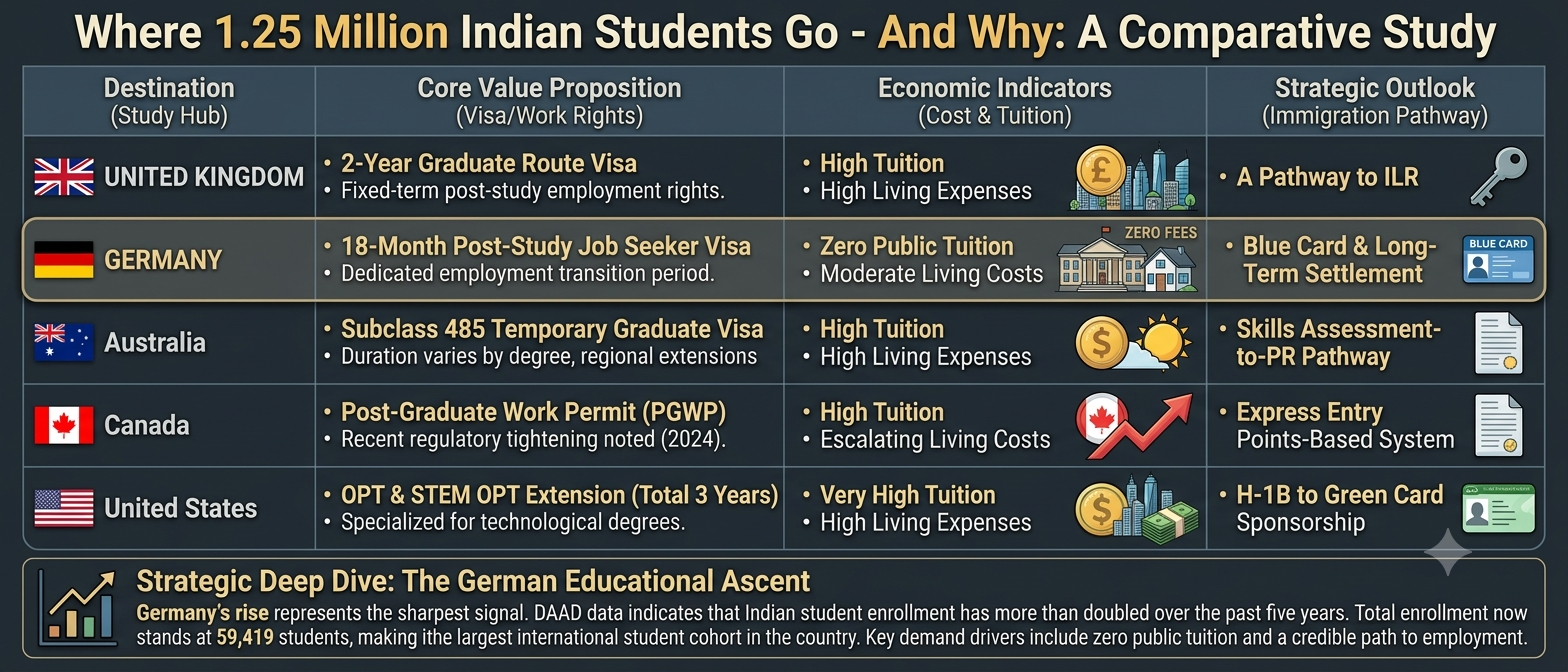
The distribution of Indian students abroad is not random. It is highly intentional, shaped by post-study work policies, tuition economics, and long-term immigration pathways.
Germany’s rise is the sharpest signal. DAAD data shows Indian enrollment there more than doubled over five years, reaching 59,419 students - making Indians the single largest international student group in the country. When a destination offers zero tuition and a credible path to employment, word travels fast through families in Tamil Nadu, Punjab, and Kerala.
The Retail Democratization of Abroad Education
For most of the 20th century, foreign education was a luxury available only to the wealthy. That arithmetic has fundamentally changed. Public Sector Banks disbursed education loans to 7,36,580 students in FY 2023–24, up from 6,29,594 the year before - a 17% annual growth rate that signals a structural shift in access, not just aspiration.
The Post-Study Work Visa has become the true ROI metric for the Indian middle class. These families are not paying for a degree - they are financing a work permit with an education attached. The loan repayment model only functions if the graduate earns in a stronger currency for two to three years post-graduation.
EDCOM INSIGHT: Over 65% of India’s population is under 35 (PIB). The capacity of top-tier domestic institutions has not grown in proportion to this demographic surge. The supply-demand gap is the single largest structural driver pushing students outward - and it will not resolve in the next decade.
What This Means for India’s Next Decade
The outward migration of 1.25 million students annually sits within a wider capital outflow: total remittances abroad under the RBI's Liberalised Remittance Scheme - covering education, travel, investment, and family maintenance combined - stood at roughly $29 billion in FY26, of which education-specific remittances alone totalled $2.31 billion (RBI data). Beyond the economics, it signals something deeper: an entire generation’s crisis of institutional confidence.
Until India’s higher education system bridges the chasm between massive graduate supply and quality job creation - and until the curriculum evolves beyond its rigid, examination-heavy framework - international education will remain the primary vehicle for Indian youth seeking a resilient, globally recognised future.
The students voting with their visas are not rejecting India. They are accepting its current limitations, and making a rational, if painful, calculation. The question for policymakers, institutions, and employers is not how to stop them - but how to build something worth staying for.
Sources: Ministry of External Affairs (MEA) 2025 · DAAD Germany · RTI IIT placement data · NITI Aayog, "Roadmap for Job Creation in the AI Economy" (2025) · Press Information Bureau · Ministry of Finance education loan data · RBI Liberalised Remittance Scheme data. This article was prepared by EdCom. All data sourced from official government and institutional publications.
© 2026 Edcom. All rights reserved. For permissions and media enquiries, contact advisory@edcom.in